
Guides
What Chips Do AI Video Generators Use?
AI video generators do not rely on a single special chip. In practice, they run on high-performance GPUs and other accelerator hardware that can process…

AI video generators do not rely on a single special chip. In practice, they run on high-performance GPUs and other accelerator hardware that can process large neural networks quickly. For users, the important takeaway is simple: the faster the chips behind the system, the smoother the video generation experience and the quicker you get your result.
This article explains what kind of chips AI video generators typically use, why those chips matter, and what that means for short-form tools such as Seedance 2.0, which supports text-to-video and image-to-video generation, up to 1080p resolution, and clips up to 15 seconds.
1) The Main Chips Behind AI Video Generation
Conclusion: AI video generators usually depend on GPUs, not ordinary CPUs, because video generation is compute-heavy and parallel by nature.
Why GPUs are the standard
AI video generation involves running deep learning models over many frames and pixels at once. GPUs are designed for parallel computing, which makes them a natural fit for this workload. Compared with general-purpose CPUs, GPUs can handle the large number of matrix operations required by generative models much more efficiently.
What this means in practice
When a platform advertises fast generation, support for higher resolutions, or smoother rendering, that performance is usually powered by GPU-based infrastructure. The model may be accessed through a web app or API, but behind the scenes the system still needs powerful accelerator chips to generate short clips efficiently.
Practical advice
If you are choosing an AI video generator, look for:
- Support for short generation times
- Clear resolution limits
- Stable rendering for the clip length you need
- API access if you want to integrate generation into workflows
2) Why AI Video Generators Need High-Performance Hardware
Conclusion: Video generation is more demanding than text generation because it must create coherent visual motion over time, not just one image or one sentence.
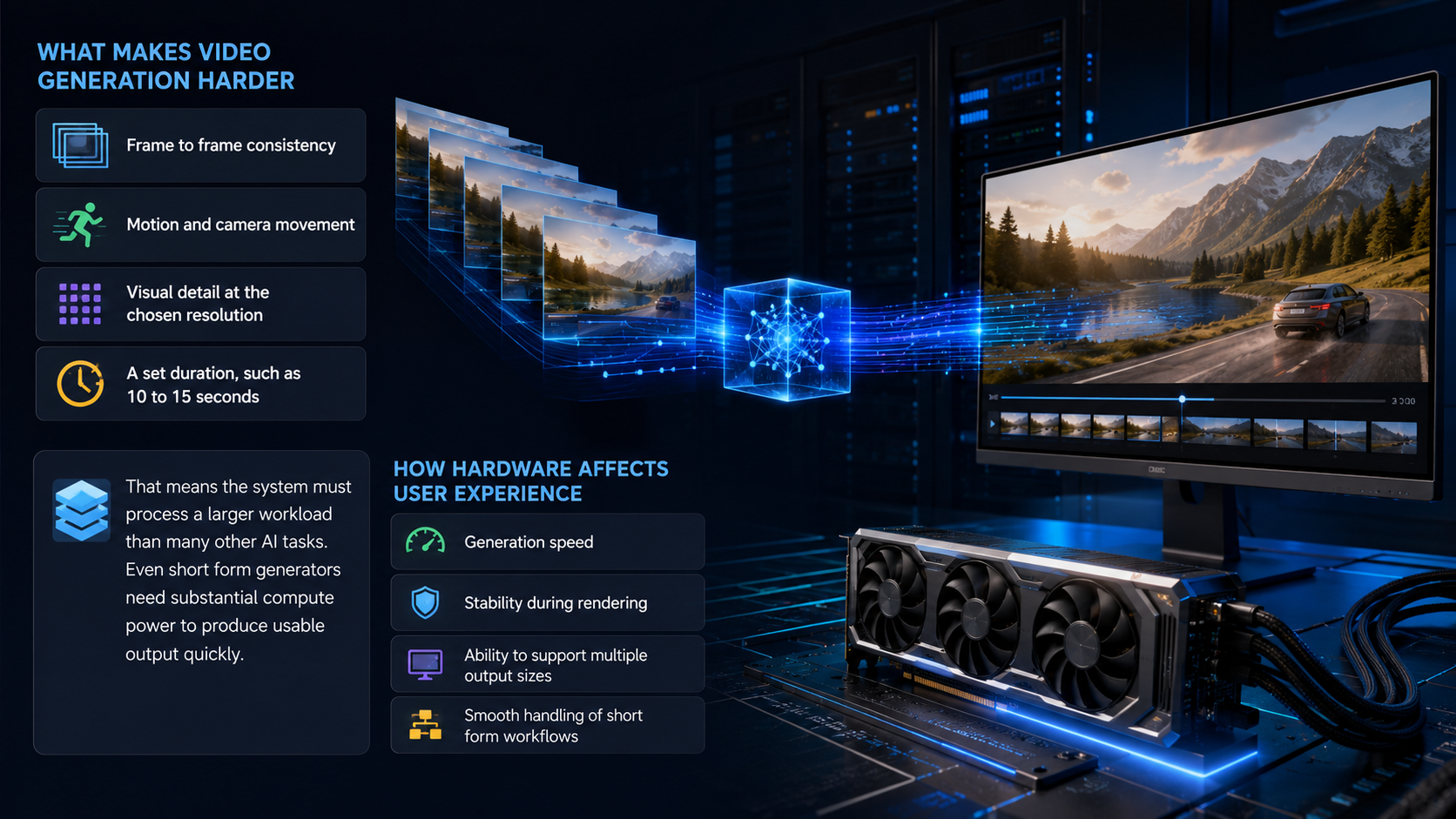
What makes video generation harder
A video model must account for:
- Frame-to-frame consistency
- Motion and camera movement
- Visual detail at the chosen resolution
- A set duration, such as 10 to 15 seconds
That means the system must process a larger workload than many other AI tasks. Even short-form generators need substantial compute power to produce usable output quickly.
How hardware affects user experience
Strong chip performance can improve:
- Generation speed
- Stability during rendering
- Ability to support multiple output sizes
- Smooth handling of short-form workflows
For a tool like Seedance 2.0, the current scope is built for short-form production, with support for up to 1080p and 15-second videos. That kind of workload still benefits from fast accelerator chips, even though it is not long-form video creation.
Practical advice
If your goal is social content, ads, explainers, or product clips, short-form tools with GPU-backed infrastructure are often a better fit than systems built for long, cinematic renders.
3) What Kind of Hardware You May See in Real AI Video Systems
Conclusion: Most AI video systems use GPU servers or cloud accelerator hardware, while end users usually never interact with the chip directly.
Common hardware pattern
A typical AI video generator may run on:
- GPU servers in the cloud
- Specialized accelerator hardware for inference
- Infrastructure optimized for low-latency model execution
For users, this means the app can deliver generation through a browser or API without requiring local hardware on your own device.
Example from a short-form generator
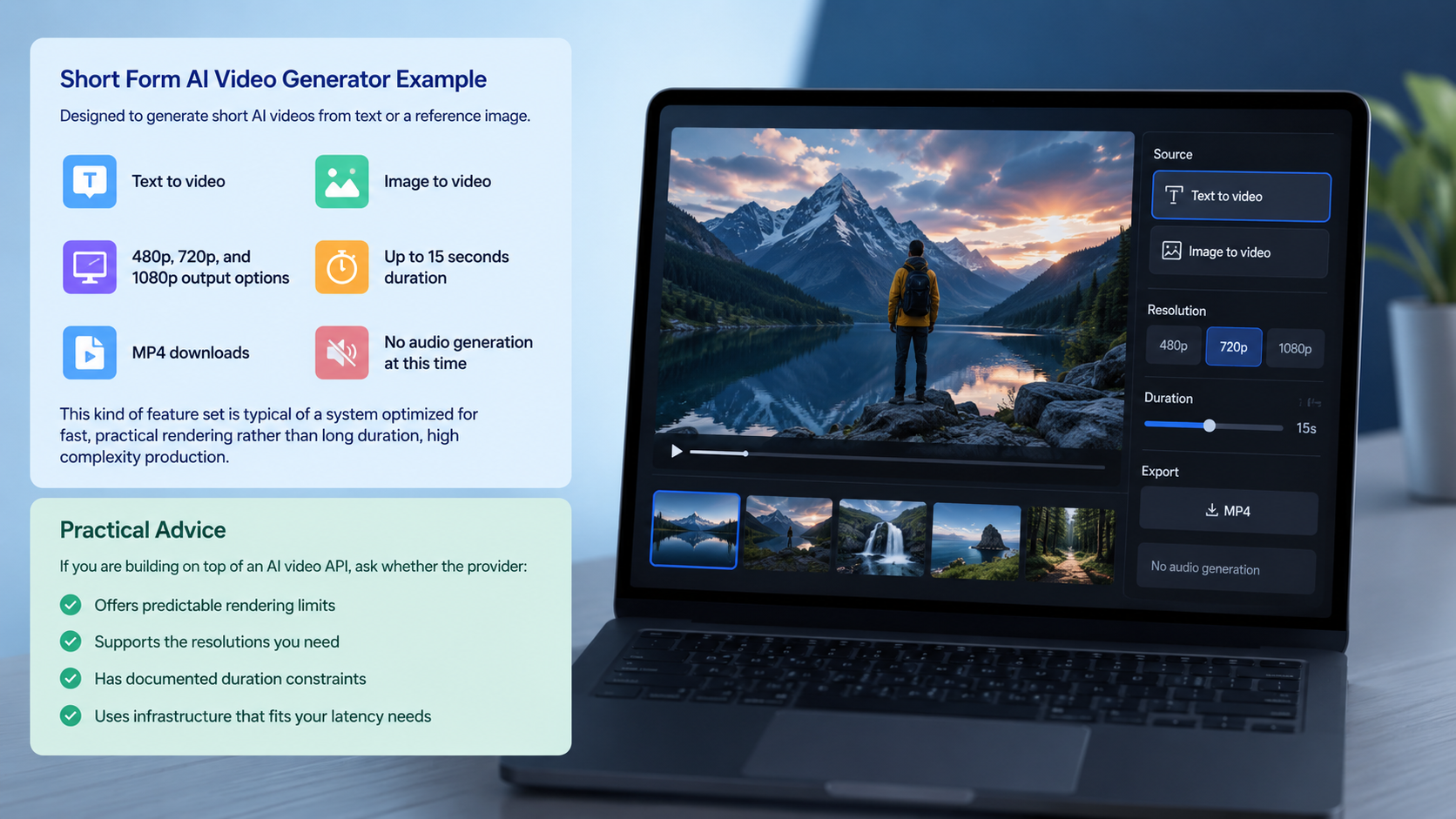
Seedance 2.0 is designed to generate short AI videos from text or a reference image. It supports:
- Text to video
- Image to video
- 480p, 720p, and 1080p output options
- Up to 15 seconds duration
- MP4 downloads
- No audio generation at this time
This kind of feature set is typical of a system optimized for fast, practical rendering rather than long-duration, high-complexity production.
Practical advice
If you are building on top of an AI video API, ask whether the provider:
- Offers predictable rendering limits
- Supports the resolutions you need
- Has documented duration constraints
- Uses infrastructure that fits your latency needs
4) What Users Should Expect from Chip-Powered Video Generation
Conclusion: Better chips do not automatically mean unlimited video length or perfect quality, but they do help platforms deliver short clips more efficiently.
Understanding the limits
Even with strong hardware, AI video generators usually set boundaries on:
- Maximum duration
- Maximum resolution
- Input type
- Supported output format
For example, Seedance 2.0 currently supports short clips up to 15 seconds, with output options up to 1080p and downloadable MP4 files. Those limits are product decisions as much as technical ones.
Why this matters for creators
If you are making:
- Product teasers
- Fashion clips
- Explainers
- Lifestyle posts
- Short entertainment videos
then a chip-optimized short-form generator can be a practical solution. You do not need a system built for feature-length production if your real use case is 10 to 15 seconds of social-ready content.
Practical advice
Match the tool to the task:
- Use short-form generators for quick content creation
- Choose higher resolution only when needed
- Start with text-to-video or image-to-video depending on your input assets
- Check whether audio is supported if your project requires it
Chip and Capability Summary
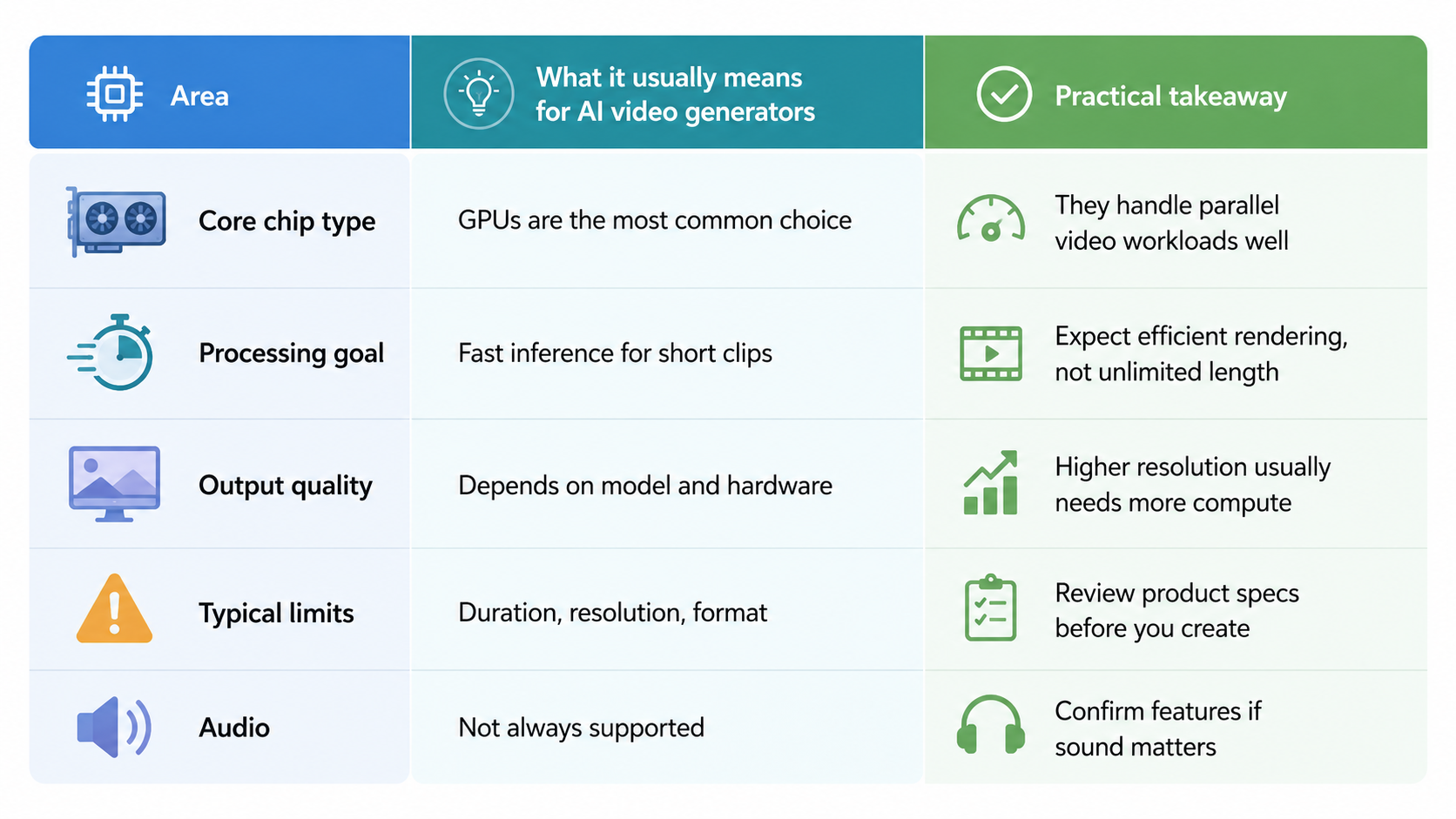
| Area | What it usually means for AI video generators | Practical takeaway |
|---|---|---|
| Core chip type | GPUs are the most common choice | They handle parallel video workloads well |
| Processing goal | Fast inference for short clips | Expect efficient rendering, not unlimited length |
| Output quality | Depends on model and hardware | Higher resolution usually needs more compute |
| Typical limits | Duration, resolution, format | Review product specs before you create |
| Audio | Not always supported | Confirm features if sound matters |
FAQ
Do AI video generators use CPUs or GPUs?
They usually rely on GPUs for the main generation workload because GPUs are better suited to the parallel computations used in video models.
Do AI video generators use special chips?
Some systems may use specialized accelerator hardware, but the most common answer is still GPU-based infrastructure.
Does better hardware mean longer videos?
Not necessarily. Hardware improves processing performance, but product limits such as 15-second duration are usually set by the platform.
Can an AI video generator work without powerful chips?
Not for serious video generation at scale. The model needs high-performance compute to render frames efficiently.
Does Seedance 2.0 generate audio?
No. The current focus is short-form video rendering, and audio generation is not supported.
Conclusion
AI video generators typically use GPUs and other high-performance accelerator chips because video generation is a demanding, parallel computing task. For users, that hardware power translates into faster rendering, support for short clips, and practical output options like MP4 downloads and multiple resolutions.
If you are evaluating a tool such as Seedance 2.0, focus less on the exact chip model and more on what the platform can do for your workflow: text-to-video, image-to-video, up to 1080p, and up to 15 seconds for short-form production. That is the information that matters most when choosing the right AI video generator.